
Schools and universities in steel framing, ready in months
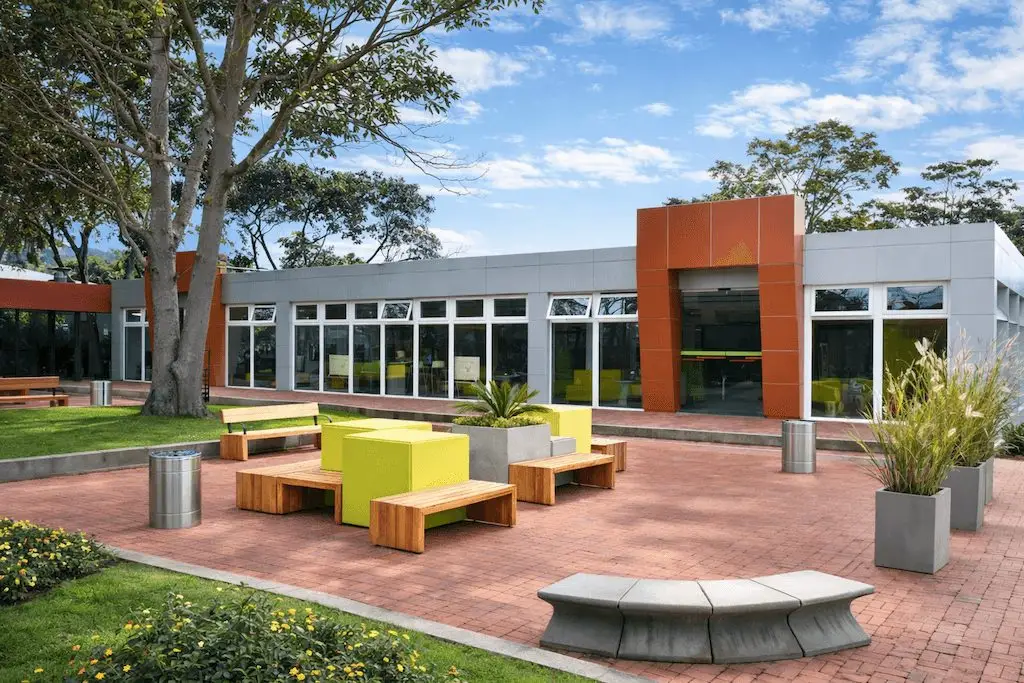
SmartBrix Construction builds permanent education buildings in steel framing (cold-formed steel, CFS) and relocatable modular classrooms. For Universidad del Rosario (Sede Mutis and Sede Norte, Bogotá), it built 11,500 m² (about 123,800 sq ft) in 100 days of site work. Construction is dry and phased so the campus keeps running, and every project is designed to NSR-10 and REP-2021.
Completed project in Colombia
Universidad del Rosario — Sede Mutis and Sede Norte
11,500 m² in 100 days · Bogotá, Colombia · Steel framing.
See photograph, scope and factsMore cases: Ministry of Defense · Corporación Universitaria de la Costa.
- 4 documented education projects in Colombia and Panama, with verifiable area, schedule, and location.
- Universidad del Rosario: 11,500 m² in 100 days (Sede Mutis and Sede Norte, Bogotá).
- Colegio Bilingüe: 1,100 m² (about 11,800 sq ft) in 8 phases without interrupting classes (Panama City).
- Two systems: steel framing for permanent buildings and relocatable prefabricated modular classrooms.
Building for education without stopping the school year.
Fixed academic calendars, occupied campuses, and demanding codes leave no room for an uncertain schedule.
A campus cannot close for construction. The academic calendar leaves short work windows (breaks, holidays between semesters, and weekends), and every week of delay means classrooms that do not open on time. Traditional wet, sequential construction rarely fits those windows, so the schedule stretches and the job site shares the campus with students, noise, and debris for too long.
SmartBrix changes the construction sequence. While foundations go in on campus, the structure is fabricated in parallel at the group's CNC plant, operated by NewCon Steel® in Las Mañanitas under the EMMA regime, in Zn-Al-Mg 275 g/m² steel with a ±0.5 mm (±0.02 in) fabrication tolerance. On site, work is limited to dry assembly: less noise, up to 30% less construction waste, and a build up to 90% faster than traditional construction. An education building in steel framing typically takes 3–5 months from foundations, and prefabricated modular classrooms are deployed in weeks.
Student safety also calls for phased work: each zone is isolated and built while the rest of the campus operates normally. Colegio Bilingüe in Panama City was built this way: 1,100 m² in 8 phases, without interrupting classes. Every project is designed to NSR-10 in Colombia and REP-2021 in Panama, with electrical systems to RETIE, Colombia's electrical code. Work is carried out under PEB Corp Group's integrated management system, certified to ISO 9001, 14001, 45001, and 37001. Area, schedule, and city for each documented project are in the project portfolio. PEB Corp publishes the engineering case study for the Universidad del Rosario campuses.
Six advantages for schools and universities.
What industrialized construction solves on a campus, with evidence from delivered projects.
-
01
Delivery between academic terms
Steel-framed buildings in 3–5 months from foundations and complete modular projects in 60–120 days. Construction is scheduled so classrooms open at the start of the term, not halfway through it.
-
02
Phased work without closing the campus
The structure arrives fabricated and is dry-assembled in stages. Evidence: Colegio Bilingüe in Panama City was built in 8 phases (1,100 m²) with classes running throughout.
-
03
Learning spaces designed to code
Design and structural calculations to NSR-10 (Colombia) and REP-2021 (Panama), electrical systems to RETIE, and cold-formed members to AISI S100. Permit documentation is part of the scope.
-
04
Classrooms that grow and relocate
Interconnectable modules grow with enrollment: they expand classroom by classroom and, when demand changes, are dismantled and relocated to another campus.
-
05
Acoustic and thermal comfort by design
Wall assemblies are specified layer by layer in the BIM model, room by room: classrooms, laboratories, and libraries get acoustic and thermal insulation defined before fabrication.
-
06
Low maintenance
Zn-Al-Mg 275 g/m² steel profiles and dry assembly: a dimensionally stable, corrosion-resistant structure that needs little maintenance.

Colegio Santa Luisa · 2,500 m² (about 26,900 sq ft) in 3 months · Bogotá, Colombia
Four education projects with verifiable figures.
Each card shows area, schedule, and city, and links to the project entry in the portfolio. A reference project’s area and delivery period describe that case; they do not guarantee another building’s schedule.

Systems, timelines, and codes for the sector.
The data an infrastructure director needs to evaluate the industrialized option.
- Systems
- Steel framing (LGS/CFS) for permanent buildings · prefabricated modules for relocatable classrooms
- Timelines
- Modular classrooms in weeks · education buildings in 3–5 months from foundations · complete modular projects in 60–120 days
- Codes
- NSR-10 (Colombia) · REP-2021 (Panama) · RETIE (Colombian electrical code) · IBC · AISI S100
- Delivery model
- Turnkey: BIM design and engineering, steel fabrication at the group plant (NewCon Steel®), logistics, civil works, and erection under one contract
Frequently asked questions about modular schools.
How long does it take to build a modular school?
Can you build while the school is open?
Do modular classrooms meet building codes?
How much does a prefabricated school cost?
Related guide: Steel-framed schools in Colombia: schedules, NSR-10, and phased work →
Your next education building, ready in months.
Tell us the area, use, and location of the project. Reply within 24 business hours · technical proposal / quote in 48 h.